Showing posts with label Cartooning Business. Show all posts

Tuesday, March 8, 2011

Sam Gross: 27,592 Cartoons and Counting

In this age of hype, maybe a hyperbolic phrase like "if you read only one cartoonist interview, the read THIS one" would come as ho hum and cliched. But, really, this is one of the best interviews with one of the greatest cartoonists and well worth the time to take in.


Above: Matt Diffee, Sam Gross and Ken Krimstein at the June 24, 2010 Bunny Bash.

Veteran cartoonist Sam Gross gives a career-spanning interview to Richard Gehr at TCJ.com.

Below are just 2 of the many informative questions and answers from the piece:


Above: an early wordless Sam Gross cartoon.

RICHARD GEHR You seem very organized. What’s your working process? How many cartoons do you generate per week?

SAM GROSS Every Wednesday I just clear everything, sit down, and trip. I don’t draw for markets like The New Yorker at all. I just trip. I’m still doing stuff as if National Lampoon still existed. This week I got sixteen or seventeen drawings. I number and date all my drawings. First they get photocopied on forty-four-pound stock paper. Then I punch three holes and they go into loose-leaf books like the black books back there and in the kitchen. And I think I got 27,592 cartoons now.


Above: Another early Gross cartoon.

GEHR: What’s your equipment?

GROSS: Number 1 and 2 ½ Rapidograph pens. That’s it. And a pad of cheap-shit paper. This is twenty-four-pound stock scratch and for finishes I have two-ply vellum.


Related:

1987 S. Gross Interview

Sam's famous "frog legs" cartoon on eBay

Some of Sam's early cartoons from the book TABOO edited by Charles Preston (1966): Parts one and two.

And it's true what Sam says: Bill Woodman is one great cartoonist.

1970: More of Roy Crane's Scrapbook


From the dusty pages of Cartoonist PROfiles #6, May 1970, comes "More of Roy Crane's Scrapbook."


Mr. Crane shows and tells about panel composition and, the above case, dramatic angles.


Above: "the Value of Black" in the composition.


The scrapbook was originally put together for Crane's assistant.


A big hat tip to Don Orehek for this issue of Cartoonist PROfiles!

Related:

Cartoonist PROfiles #3 Roy Crane Scrapbook "How to Draw Buz Sawyer"
Cartoonist PROfiles #38 Roy Crane Scrapbook "How to Draw Women"
1968 Visit with Frank King and Roy Crane
Roy Crane" The Rise and Fall of the Comic Strip"

Tuesday, March 1, 2011

Roy Crane "The Rise and Fall of the Comic Strip!!"

America has been going to hell in a handbasket since the signing of the Declaration of Independence.

There is no shortage of yellowing, old diary entries, newspaper editorials and books bemoaning that this age will be, once and for all, mark my words, the ever lovin' blue eyed end. OK? Right now. It's all over. The "good old days" are lost.


With this thought in mind, here is master cartoonist Roy Crane, writing "The Rise and Fall of the Comic Strip!!" The comic strip, you see, died in the 1970s; specifically, the December 1973 issue of Cartoonist PROfiles.


Here's the text of "The Rise and Fall of the Comic Strip!!" including a peek into the future of 1983:


1895
  • First Daily Strip
1905-20
  • Joke Era ... daily strips 15" wide (7 Cols.)
  • Full Sunday Page
1920-30
  • Development of continuities into story strips, adventure strips.
1930-40
  • DEPRESSION ... Golden Age of the adventure strip ... ALL THAT SPACE ... wonderful fights, action, BACKGROUNDS!
  • Publishers amazed that circulations doesn't stop. Publishers find readers want to know what will happen next in adventure strips.
  • Throw out the joke strips!
  • Buy MORE adventure strips!
  • Gratitude ... papers kill goose that lays the golden egg, cut dailies to 6 columns.
  • Cut Sundays to 1/2 page and tabloid!
1940-45
  • THE WAR! Comics play a big part. Price of newsprint soars.
  • Cut dailies to 5 columns.
  • Cut Sundays to 1/3 page!
1945-65
  • U.S. Comics in the Louvre ... called ART!
  • Cut dailies to 4 columns.
  • HELP! HELP! They're after the old goose again!
  • Cartoonists in serious trouble! Not enough space for adventure and story strip lads to get characters' feet into pictures.
  • Not enough room for action shots.
  • All strip artists go from 4-picture strip to 3-picture strip!
  • Adventure and story strip guys have 72 fewer pictures to tell 12 week story.
  • Readers squawk!
  • Stories drag!
  • Lose wallop!
  • Gag strips take over market.
  • TV Competition.
  • 1965-73
  • More troubles!
  • Newspaper reduce size of he column which takes another chop out of comics.
  • OFF WITH THE LEGS!
  • Fewer action shots!
1973
  • STRIKES! Shortage of newsprint.
  • They're going after the old goose again!
  • PAPERS GOING TO 3-COLUMN STRIPS!!
  • Yes ... THREE!! And demanding larger lettering!
  • Gag strip fellows draw strip in only one Picture.
1974
  • Papers cut strips to 11/2" deep.
  • NO MORE BREASTS. Only heads are left.
  • Last story strip folds! Last adventure strip!
1975
  • Papers chop comics to 2-columns.
1977
  • Papers chop heads off: leaving only the balloons.
1978
  • Polls show no one is reading bare balloons any longer. Editors wonder why. Last comic disappears.
1983
  • NEW ERA in American Journalism!
  • Editors drop the news!
  • TV blamed!
  • Issues appear twice weekly ... the supermarket special on Thursday, want ads on Sunday.
  • Let us thank God we can still get the news on TV. Also sports, weather, recipes. In fact, EVERYTHING the newspapers carried except the COMICS!


A big hat tip to Don Orehek for this issue of Cartoonist PROfiles!

Wednesday, February 2, 2011

Video: Comic Book Artist Peter Gross and MIX

For a short video (about 3 minutes, plus a damn 30 second advertisement in the beginning), this Star Tribune profile of Peter Gross (LUCIFER, CHOSEN, BOOKS OF MAGIC) packs a lot of information about who he is, what he does, and how he draws.


The article then focuses on the cartoonists in the Twin Cities area, with the prediction that most will be female in the coming years. Well worth a read, and it makes me consider dropping in for the next Minneapolis Indie Xpo.

Below: a fun & informative short video from the gang behind MIX about the 2011 Xpo, to be held November 5-6, 2011 at The Soap Factory in Minneapolis, MN:

Thursday, November 4, 2010

Where Do You Get Your Ideas?


"Where do you get your ideas?" is one of those ubiquitous questions that cartoonists get asked.

I wish I could cite one source.

After you've been cartooning for a while, you're always on scanning mode; looking for ideas wherever you are.

It's rare that I am able to overhear something that's a punchline. Thinking about buzzwords can help, but I think that the last panel of the comic below, staring at a wall, is what a lot of cartoonists do, and it's probably the most productive!

Here are 4 panels on the topic of ideas that I originally drew for an interview. The piece was not used. It's published here for the first time.

Tuesday, October 26, 2010

Cartoonist Dedication

I just got an email from a young, just-starting-out cartoonist who lives in the UK, and is having a hard time finding markets. He asks for advice. I thought I'd respond here.


(Above: a cartoon of mine from the Harvard Business Review. Yes, a cat cartoon in a business mag! A refreshing change of pace from the "people in meetings" cartoons and the "boss at his/her desk" cartoons.)

The great thing about cartoons is that EVERYONE loves cartoons. Whether it's cartoons on TV or Mad Magazine or Marvel or gag cartoons -- people love their cartoons. And every time you see a cartoon, there's a real person, somewhere, who drew the cartoon, designed the character, designed the toy, wrote the story, etc.

You all ready know it's a lot of dedicated work to get to be a pro. That's good! Only the most persistent and dedicated cartoonists make it. The real pros out there have seen a lot of rejection. It's normal.

When Joe Kubert is asked what does he look for in a new student for his Joe Kubert School of Cartoon and Graphic Art (which is in its 34th year in 2010), he replies, "Dedication."

Not someone who is in it for the money, the "the most talented," not the one with all the art credentials, not the one from the city, not the rich one, not the one with the connections.

I draw magazine cartoons. I did not go to school to learn to cartoon. When I was a kid, growing up in the Midwest, there were no schools for cartoonists. I just was dedicated and persistent.

At a 2006 Museum of Comic and Cartoon Art exhibit of the very successful comic artist Todd MacFarlane, there was a case full of Todd's rejection slips; hundreds of them!

Every successful person I know (a) worked at their craft and (b) got rejected. There are no secrets. The good stuff floats to the top and gets noticed.


This is an edited version of a June 27, 2008 blog entry.

Wednesday, August 25, 2010

Getting Paid


"If you kept up with my blog, you'd understand."


I sold some cartoons to a client. I emailed the finishes to the editor and invoiced him that day. (The above cartoon is not one of the cartoons. It was bought by a very good market that pays consistently on time. I'm just using it as an illustration.) This client is supposed to pay within 30 days.

Over a month goes by, no payment.

I sent a friendly reminder email last week and then, yesterday, I left a phone message. "Hi, uh, it's Mike calling. Just want to know if there's a check in the mail. It's my rent time. Ha, ha." (That's not a joke, really. I do have to pay New York rent, which is NOT CHEAP.)

No answer.

Now, it's my personal rule not to let things get behind. Sometimes there are good reasons why I don't get paid. Not all the time, but some times. I'm open to there being a problem on their side. And I want to be civil and friendly. No confrontations. Regardless, I'm frustrated that the editor won't contact me.

So today I checked out the site for the magazine. This is a national mag, on newsstands from coast to coast. The site was there, operating just fine. So then I looked at this feature called EDITOR'S BLOG.

One of the topics for the blog: "Freelancing has never been an easy way to make a living. Is it getting harder?" And there's a place to MAKE COMMENTS.

The editor won't return my call, but he has time to blog. Hmm.

Like I said, I'm not making this up.

Hmm. Is freelancing getting harder?

I immediately thought of Al Jaffee's Snappy Answers to Stupid Questions.

"No, it's not hard since I've given up eating."

"It'd be a lot easier if you'd just PAY ME."

"My mom is gonna call your mom and then, oh boy, you're going to be in a lotta trouble."

This isn't the first time that it's happened to me. I just try to be persistent and nice. "Is there anything else that you need? Can we go over my contact details again? Can you Fed Ex a hand-written check?" And if I get a non-responsive person on the phone, I counter with, "What would you do if you were in my situation?"

Well, I won't post a comment on that mag's blog. I won't say what magazine it is. Hopefully, it will work out. Especially if I'm persistent about it. I suppose there's a chance of the editor somehow seeing this blog and -- BOOM! -- no more business from him. Ah well.

The darn thing is, it's such a small bit of money to the corporate world. It's a plane ticket. It's lunch for board. It's a car rental.

Besides my sweet big cat Roo getting in my way as I draw, this is another time drag; another reason I don't produce more cartoons! Too much time spent in the Mike Lynch Accounts Receivable Department.

----------------

This has been an encore presentation of the Mike Lynch Cartoons blog. The above appeared in its original form on March 2, 2006.

Monday, August 23, 2010

Cartoon Invoices

I've gotten a couple of emails asking how to invoice, what IS an invoice, etc.

So, let's take a chapter from the ol' MIKE LYNCH COLLEGE OF CARTOON KNOWLEDGE.

It's great when you get that letter, email or phone call letting you know that you sold a cartoon. A lot of the time, when I'm home with a snoozing cat next to me, drawing, I can only wonder, "Are these funny? Funny enough to SELL?!"

A sale is vindication that you did all right. You targeted a market, came up with some appropriate, sellable, professional work. But, better yet, someone else thought what you did was funny, and they have money for you.

And, they tell you, please send an invoice.
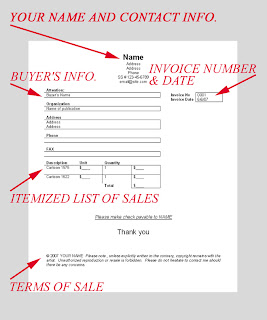

An invoice is, as you all ready know, the bill that the accounting people need at the magazine, ad agency, Web site or wherever you sold your work. For me, it's usually a magazine or Web site.

I put the above invoice together in Word, based upon typing the word "invoice" into Google, and then picking and choosing what elements I wanted.

YOUR NAME AND CONTACT INFO. goes at the top. I make my name big, since that's the name that goes on the check. I include my Social Security number.

Early on, I had my NAME and, right under it, MY WEB SITE -- both in big letters. One time, a client mailed me a check made payable to my Web site. It took 2 phone calls and 4 weeks til I got another, correct, check. Now I just put my name up top in big letters -- and then I ask again to "make check payable to Mike Lynch" at the bottom.

BUYER'S INFO. is all the information you have on your client. You need this. It really helps to have their phone number, email, etc. on file. If you don't know their phone number, email them and ask. Tell them YOU HAVE TO HAVE IT. For a first time client, I want all of their information. And I do ask, if given a PMB or PO or Suite number, for a real bricks-and-mortar address.

INVOICE NUMBER & DATE You may want it for reference. Usually, when the payment arrives, the number and date will be on their check to you so you can cross reference. If you get the check and there's a problem, then having these numbers on your original invoice will enable the accounting people to figure out what happened. Recently, I sold a couple and when I got the check, it was for half the sale. I found out that it was my fault: in the Total column, I only noted one sale. A dumb mistake!

ITEMIZED LIST OF SALES ensures that everyone understands that the sale is for a particular cartoon. I put a number on the back of all my cartoon originals, and that gets written on the invoice. It means nothing to the buyer, of course, but for me, it tells me exactly which cartoon I sold. I also write the caption or general description of the cartoon on the invoice.

TERMS OF SALE is something that you want to consider. Mine establishes legal authorship of the work, letting the buyer know that the cartoon is mine. In other words, the person buying the cartoon does not now own the cartoon. The routine sale is for one-time use. Rarely, just every once in a while, someone will think that they now own a cartoon you made and that they can put it on t-shirts, etc.

- The following is a revised version of a June 6, 2007 blog entry.

Tuesday, May 18, 2010

Rina Piccolo: How To Get Your Cartoons Into The New Yorker

Here is the first part of Rina Piccolo's experience of going to The New Yorker offices:

Let me say something about editors here — the good ones don’t say things to be nice. At this level of the game there’s no space for that. I know cartoonists who have sat in Bob’s office and listened to him say things about their work that could be considered unkind. Later on, I myself was told things about my drawing style that I didn’t agree with. But this is the editorial process, and if you’re a professional, you just don’t go home and cry about it. Well, you can, just don’t tell anyone about it.

This is the first part of a multi-part series of how to submit to the magazine.

Wednesday, April 28, 2010

The Business of Cartooning: Your Signature


One of the nice traditions of cartooning is that usually, somewhere discretely, there is the signature of the cartoonist. You don't get that, for instance, on the Tony the Tiger drawing on your box of frosted flakes, do you? (But you should. That would be nice.)


Above: How I used to sign my cartoons.

I started looking at some signatures of gag cartoonists through the years. Here are some scans from a few cartoon books. You probably know the names:


Most of the signatures are bold, and some use just a last name, or a nick name (like TAD or VIP). Some sign using their full name.

I thought that I should change my signature to the latter -- from just "Lynch:"


... to "Mike Lynch:"


I made the letters more angular. Sometimes the "L" in "Lynch" looked like a "C."

OK, this may solicit a shoulder shrug. Who cares? It's not a big deal kind of change. But, look: writing my first and last name on each cartoon I draw makes me an easier guy to find.

Case in point:

I got an email from a fellow in London. He had been on his lunch hour, and seen my cartoon in a magazine at the newsstand. This fellow didn't buy the magazine, but remembering my name, he walked back to his office, Googled me and found my site. His UK company was going to do a big ad campaign, and would I be willing to draw some cartoons for it?

Like I said, we have a custom of signing our name. This is not just a nice custom, but a way to generate revenue.